Francisco Valdés: Artificial


Cecilia Brunson Projects is pleased to present Artificial, an exhibition of new paintings by Francisco Valdés (b. 1968, Santiago, Chile). This marks the London-based artist’s second solo exhibition with the gallery. On Friday, 27 February, the gallery will host an opening reception with the artist, followed by a conversation with Pablo León de la Barra, Curator at Large, Latin America at the Solomon R. Guggenheim Museum.
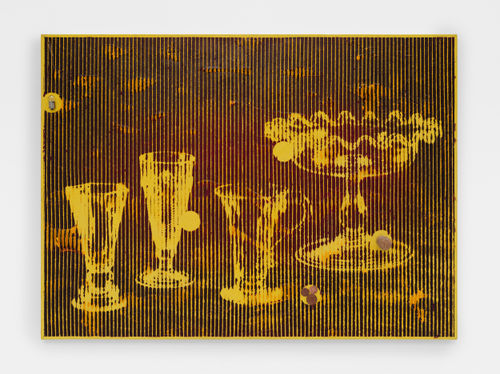
Francisco Valdés creates paintings that shift in relation to the viewer’s body: disorienting and abstract at oblique angles, sumptuously tactile at close range, and crystallising into high realism from a distance. The exhibition title Artificial may initially suggest artificial intelligence, yet for Valdés the term is rooted in something more intimate and sensorial–artificial light. It recalls the fluorescence of childhood classrooms, the sodium glow of streetlights, the hum of illuminated interiors and screens. Here, “artificial” describes what is fabricated yet formative: the atmospheres that shape memory, perception and emotion. Light becomes both subject and metaphor–a measurable physical phenomenon and a psychological condition–through which Valdés probes the unstable boundary between perception and fact.
Francisco Valdés builds on the radical Pop strategies of artists like Sigmar Polke, reworking the visual language of mass media to question truth, reproduction and power. Shaped by a Chile still emerging from decades of authoritarian rule, Valdés developed a coded, concept-driven practice within a culture where images were tightly controlled and ideologically filtered. In his kinship with post-war artists like Polke, Valdés channels an enduring artistic impulse that continues to resonate through the contemporary tumults of global politics, reminding us that images–systems of communication, memory and resistance–are never neutral.
Valdés’ paintings break down photographic images into striated bands, exposing and disrupting the visual interfaces through which we usually encounter them. He incorporates assemblage and the physical irregularities of the canvas—frayed edges, stains, ruptures—so that the image cannot be separated from its material support. In these works, public figures and everyday objects alike are stripped of certainty and represented as constructions.
Working from found photographs and circulated media, including images encountered in the endless scroll of social platforms, Valdés examines the act of seeing itself. He slows the velocity of the feed, translating pixels into paint and immediacy into duration. What is typically consumed in an instant is materially reconstructed and made to waver. In this process, the image reveals its dual nature: both a relic of a vanished instant and something insistently alive in the present. Artificial ultimately expands beyond its title to describe a condition of contemporary perception, where light, memory and mediation converge, affirming painting as a space in which images can be held long enough to be questioned and seen anew.
Francisco Valdés (b. 1968, Santiago, Chile) received his artistic training in Santiago, Chile and at Goldsmiths in London, where he lives and works. He has exhibited in numerous solo and group exhibitions internationally and was recently awarded as a finalist in the 2023 John Moores Painting Prize. His work is held in the collections of Cisneros Fontanals Art Foundation (CIFO), Miami; the Misol Foundation, Colombia; and Museu de Arte do Rio (MAR) Rio de Janeiro, among others. Valdés will be the subject of a solo exhibition at The Florence Trust, London in March 2026.
